Building for Equity: Field Resources
Building for Equity serves organizations with a focus on arts, science, heritage, and historic preservation that seek to build, remodel, and acquire spaces that facilitate their programs in King County.
We support organizations implementing their facilities projects in ways that contribute to racial equity and equitable development. No matter where you are in your process, we are here to help. Here, we’ve compiled an ongoing list of resources for Building for Equity applicants to help you achieve your facility project goals.
These resources are intended to be used as a starting point in your journey towards a long-term facility goal. Please do not hesitate to reach out for help in finding specific resources you do not see here.
About Equitable Development
About Equitable Development
We encourage organizations to consider what role they can play in fostering equitable development through their facilities projects.
Equitable development and construction practices build economic resilience in underserved communities and help sustain the cultural and science sector.
Equitable development is public and private investments, programs, and policies in geographic areas that take into account the history and current conditions to meet the needs of marginalized populations and to reduce disparities so that quality-of-life outcomes are equitably distributed for both existing residents and new residents to create strong communities.
Equity drivers include:
- Advances economic mobility and opportunity for residents;
- Prevents residential, commercial, and cultural displacement;
- Builds upon and protects local cultural assets that anchor communities;
- Supports organizational capacity building;
- Promotes transportation mobility and connectivity; and
- Enables equitable access for all communities.
* source: DCHS-King County Equitable Development Initiative Implementation Plan Phase 1
Things to Consider Before Pursuing a Facilities Project
Things to Consider Before Pursuing a Facilities Project
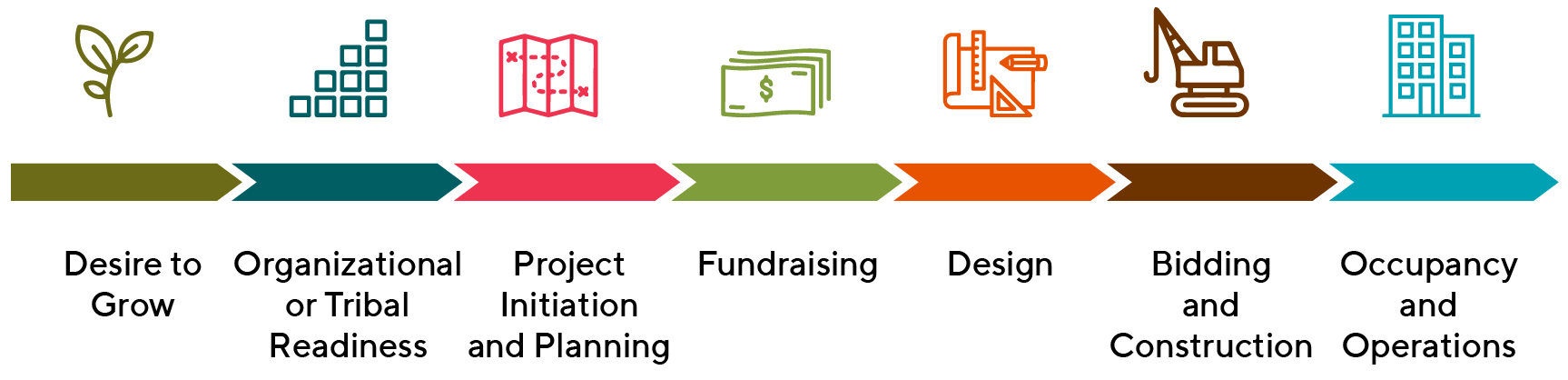
Building for Equity grants focus on organizations planning and building a facility in these phases.
Phases toward completing a Facilities Project
- Check out the Cultural Space Handbook, a guide through stages like “getting ready,” “ownership models,” “when you find a property,” “rehabbing your space,” and much more by the Cultural Space Agency.
- Before You Begin: What Is a Facility Project? (Nonprofit Finance Fund)
- Deciding on a Facility Project (Nonprofit Finance Fund)
- Pitfalls and Dangers to Avoid During Facilities Projects (Nonprofit Finance Fund)
- Real Estate and Facilities for Nonprofits: Early-Stage Considerations (Nonprofit Finance Fund Webinar Recording July 9, 2024)Nonprofit Finance Fund led an introductory workshop for the leaders of nonprofits focused on preparing for facilities projects. Acquiring a new facility/open space or making substantial changes to existing facilities/space is an exciting way for nonprofits to grow their impact and strengthen their ties to the communities they serve. Both immediately and over the long term, facilities projects also fundamentally change how organizations operate and fund their work. Participants will consider how to prepare for facilities projects, learn skills for managing the ongoing costs of facility ownership, and access additional planning and learning resources.Some of the main goals of the workshop include:
- Discuss the role real estate can play in advancing an organization’s work.
- Understand core concepts and terms related to real estate projects.
- Learn an approach to assessing an organization’s preparedness for real estate, particularly from a financial lens.
- Access a set of tools and resources to support an organization’s initial planning.
- Build understanding in community with peers.
About Racial Equity
About Racial Equity
Established in 2019 as a joint initiative between 4Culture, Executive Dow Constantine, and the King County Council, Building for Equity was created to support cultural building projects and create a pathway to racial equity and geographic access in our facilities funding.
With a focus on racial equity, 4Culture funds, supports, and advocates for culture to enhance the quality of life in King County. We acknowledge that systematic inequity takes many forms—racism, sexism, ableism, transphobia, heterosexism, and more. Our focus on racial equity provides us with tools we can use to dismantle all oppressions. As we work to make our practices more racially equitable, we encourage your organization staff and leadership to assess their personal knowledge of interpersonal and systemic racism and how it permeates the work of your organization and your project.
We compiled some resources to get you started.
- Take an implicit bias self-assessment through Project Implicit
- Take an organizational self-assessment developed by Of/By/ForAll
- Educate yourself about the definition of racism, internalizations of racism, and white supremacy culture at Dismantling Racism Works
- Learn about racial equity , systemic racism, and place-based strategies at Race Forward.
- Learn about historic racist policies and practices that have discriminated against people of color from owning land and property in King County and the United States.
- Racial Restrictive Covenants in King County by the Seattle Civil Rights and Labor History Project at the University of Washington.
- The Color of Law – A forgotten history of how our government segregated America by Richard Rothstein.
- Podcast — Shelf Life Community Story Project (shelflifestories.com) – See to Episode Five on Housing in Seattle’s Central District. Shelf Life lives at Wa Na Wari, a Central District home for Black art, stories, and connection.
- DCHS-King County Equitable Development Initiative Implementation Plan Phase 1 – See page 14 for the history of racial discrimination in development in Washington.
- Explore this Resource List of multimedia, books, and more compiled by Design As Protest, Anti-Racist designers dedicated to Design Justice in the built environment.
To learn more about 4Culture’s work in racial equity visit Racial Equity at 4Culture.
Build your Equitable Development Practice
Build your Equitable Development Practice
Building for Equity facility project applications with project budgets over $10m must have an equitable development practice in place for their proposed projects.
The following resources include professional development opportunities, as well as tools for planning and measuring the impact of your project on surrounding communities.
Certification, Programs, Tools and Credits
- Build Art Space Equitably (BASE) (Cultural Space Agency)
This 20-person annual cohort explores a curriculum centered on the intersection of commercial real estate, community development, and the arts - OAC Pathways (Open Architecture Collaborative)
An interactive program designed to introduce designers to methods for equity in practice, historical and systemic racism within the built environment, self-reflective and community building practices, and strategies for community engagement. - Land (In)Site — Open Architecture Collaborative calls built environment professionals, community organizers, land stewards, and agrarians to engage in spatial design thinking on the land.
- Pilot-Credits IPpc89: Social equity within the community (LEEDuser)
A starting place for participating LEED green building projects to understand their relationships to the impacted community and implement targeted strategies that address social equity. - SEED Evaluator (SEED Network)
A free online tool to help designers, project developers, community leaders and others who desire a common standard to guide, measure, evaluate and certify the social, economic and environmental impact of design projects. - Building Environmental Justice Tool
Environmental justice (EJ) & social equity issues are different and nuanced from project to project with no cookie-cutter solutions. With that in mind, this toolkit provides the data, resources, and framework to identify pressing issues and document your journey to accounting for more equitable design. - Index by Design As Protest
The Index is a tool for architects, designers, planners, policymakers, and community activists committed to taking action towards identifying and dismantling systemic racism within our practices, organizations, academic institutions, and local governments. It provides a visual way to track accountability and resources for guiding concrete actions. - King County’s Sustainable Infrastructure Scorecard
This scorecard guides King County project teams on how to meet the green building ordinance requirements. King County capital projects are required to use an approved green building rating system.
Best Practices
- The City of Seattle’s Equitable Development Framework includes six equity drivers integrating people and place to create strong communities and great places with equitable access.
- The King County Green Building Handbook is your guide to increasing efficiency in your next home project. Whether you’re building new, remodeling, or replacing old systems, we have strategies that will help you make healthier, more sustainable, and potentially cost-saving decisions.
- The Ingredients of Equitable Development Planning (Joint Center of Housing Studies of Harvard University)
- 10 Principles for Embedding Racial Equity in Real Estate Development (ULI Knowledge Finder)
- Equitable Contracting at Communities of Opportunity (Communities of Opportunity)
- Equity In Apprenticeship (Principles for Equity in Apprenticeship)
- Priority Hire Program (King County)
Resources
- The Spectrum of Community Engagement to Ownership (Movement Strategy Center)
- The People’s Practice an anti-racist community development research project made possible through support from the Robert Wood Johnson Foundation by ThirdSpace Action Lab.
- Spatial Futures Initiative Program Database an accessible, well-organized platform for practitioners, researchers, policymakers, and advocates to explore and implement strategies that foster equitable spatial development. Spatial Futures Initiative is a PolicyLink Project that aims to be a potent catalyst and visionary policy hub for reparative spatial justice work in land and housing.
- King County Executive Climate Office manages King County’s Strategic Climate Action Plan (SCAP); collaborates with county departments, frontline communities, and other partners on climate-related work; and manages programs to build a green workforce, prepare for the impacts of climate change, and empower healthy buildings.
Looking for Consultants?
Looking for Consultants?
Explore our ever-growing library of consultants and resources for nonprofit organizations in King County.
Resource Library
This library includes access to consultants and resources supporting the following topics and more:
- Accessibility (language, ADA, facilities, mobility)
- Diversity, Equity, Accessibility, and Inclusion
- Financial emergency planning
- Financial Planning and/or Strategy
- Fundraising/Development
- Legal Services
- Strategic Planning
- Architecture for pre-design through design/development
- Commercial Real Estate Brokerage
- Facilities Development and/or Owner’s Representation
- Land Use and real estate legal services
- Technical Assistance Grant Writing
For Building for Equity: Project Development grantees, staff pair grantees with consultants to support their project development work at no cost to the grantee. Support is budgeted at approximately $1,850 (10 hours) in services per grantee for the duration of their current Project Development contract.
For questions on how to find a consultant using our Resource Library, contact Building for Equity Program Managers, Maya Santos at or Jayden Robles at .
Looking for Equitable Funding Opportunities?
Looking for Equitable Funding Opportunities?
- Cultural Facilities Fund (Seattle Office of Arts & Culture)
- Equitable Development Initiative (Seattle Office of Planning & Community Development)
- Business Community Ownership Fund (Seattle Office of Economic Development)
- King County Conservation Futures (King County)
- Current Grant Opportunities (Seattle Foundation)
- Arts in Parks (Seattle Office of Arts & Culture)
- Hope Corps – Arts We Still Dream a Future: Call for Downtown Activations & Exhibitions in 2026 (Seattle Office of Arts & Culture)
- Centering Art and Racial Equity Grant (Seattle Office of Arts & Culture)
- Cultural Space Agency a mission-driven, values-based cultural real estate development company (Chartered by the City of Seattle)
- Black Future Co-Op Fund The Black Future Co-op Fund is by and for Black Washingtonians.
- Na’ah Illahee Fund Indigenous Women-led organization serving as a bridge builder, facilitator, and resource partner
- Inspiring Philanthropy in Northwest Native Communities (Potlatch Fund) Funds in support of Tribes, Tribal nonprofits, Native-led nonprofits, Native artists, and Native initiatives in the four-state service areas of Idaho, Montana, Oregon, and Washington.
- Shared Capital Cooperative is a cooperatively owned Community Development Financial Institution that invests in co-ops. Cultural organizations that are structured as a co-op (any kind of co-op) can borrow money for any kind for any purpose (working capital, real estate purchase)
State and Federal-level funding opportunities that focus on cultural and community facilities projects:
- Building for the Arts Fund (Washington State Department of Commerce)
- Building Communities Fund (Washington State Department of Commerce)
- Heritage Capital (Washington State Historical Society)
- Community Project Funding (Congresswoman Pramila Jayapal)
Looking for a Space Immediately?
Looking for a Space Immediately?
Find art, rehearsal, event, exhibition, and meeting spaces at Spacefinder
Not Finding Resources Here Near You?
Not Finding Resources Here Near You?
While we continue to develop this page to broadly serve all of King County, below are places to look for resources more local to you if not found here yet.
Your local government is a great place to start for resources and opportunities near you. Find your council district by visiting: King County Councilmembers and districts – King County, Washington
Local Arts Agencies (LAAs) provide cultural services for suburban and unincorporated communities in King County. 4Culture facilitates a network of 26 LAAs through direct funding and bi-monthly meetings, which foster innovative avenues for collaboration. Visit: Local Arts Agencies | 4Cultureto find your LAA.
Contact 4Culture Building for Equity
Contact 4Culture Building for Equity
Please get in touch with us if you have any questions or requests. We look forward to getting to know your organization and facilities project!
You can contact us about:
- Questions regarding Building for Equity grants (applying, contracting, reimbursement/payments).
- Review of draft Building for Equity grant applications.
- Scheduling a site visit or a meeting.
- Requests for a presentation on Building for Equity funding programs
- Paid and volunteer opportunities at 4Culture.
- Finding specific consultants, contractors, or other resources not found here.
Maya Santos, Senior Building for Equity Program Manager
Jayden Robles (Chumash/Cahuilla/Ohlone), Building for Equity Program Manager