Guest Post: Documenting Japanese American Histories through Digital Storytelling
Japanese American Citizens League Puyallup Valley Chapter
In the White River Valley, Japanese American history has survived as lingering memories within the dilapidated buildings and farmlands in south King County. As the 2025 4Culture Equity in Historic Preservation Intern, my focus was to create an online preservation project using Historypin, a community-built online archive, to rediscover and document the numerous stories, generational perseverance, and incredible history of Japanese American communities in the White River Valley of Washington State.
The process of documenting Japanese American heritage in this region is grounded in the restoration of memory and preservation: by mapping the spaces of daily life—farms, grocery stores, temples, bathhouses, and schools. This project aims to preserve the history Japanese American presence in the White River Valley by documenting 30 places in an online platform that geographically and visually connects past to present. As part of the Asian and Pacific Islander Americans in Historic Preservation (APIAHiP)’s East at Main Street Collection on Historypin, the project has worked to raise awareness of these locations to assist with preservation for the future. Through community contributions of archival photographs, the online platform geographically connects to the 30 locations where the photos were taken. Additionally, through an image overlay, users can visually witness how these spaces once looked and felt. HistoryPin reawakens Japanese American history in the White River Valley. Users can observe present-day sites of the Neely Mansion, a previous home of the Hori family with a traditional Japanese bath house; the Puyallup Assembly Center, where more than 7,500 Japanese Americans were incarcerated during World War II; or the Natsuhara Merchandise Store, a once social hotspot for Japanese immigrant farmers in the Auburn community (Andrews, 1997). By illustrating the range of ethnicity, religion, class, occupation, and gender that make up Asian and Pacific Islander American communities, this project has worked to create a more complete picture of United States history. The White River Valley was once a vibrant, cultural, social, and economic landscape of Japanese Americans. However, the forced removal of Japanese Americans during World War II caused many cultural communities to be disrupted.
One such story documented in this project is the enduring story of Chiyokichi Natsuhara, an established entrepreneurial immigrant in the White River Valley community in the 1900s. His early life, from building a two-room home with only fifty dollars, to running his fertilizer plant, Natsuhara & Sons, as well as a community-oriented store, embodies the entrepreneurial persistence that shaped the valley’s cultural landscape. One of Natsuhara’s most enduring contributions lay in his decades-long stewardship of the Auburn Pioneer Cemetery, where his own 3-year old daughter’s gravestone lay. There, he maintained graves and safeguarded the memory of community members, even while forcibly incarcerated at Minidoka, Idaho. His life intersects with nearly every element of this digital storytelling project: the mapping of farms and stores that once served as community anchors, the spiritual and cultural institutions that held families together, and the cemeteries and homes that survive as some of the valley’s last physical traces of Japanese American presence. Through Natsuhara’s legacy, the Historypin map becomes not just an archive of places but a testament to the individuals who preserved community identity through care, continuity, and acts of remembrance.
Some of these locations documented in this HistoryPin project are also rooted in early Japanese immigrant history. According to Jade Wahlgren, 2023 4Culture Equity in Historic Preservation Intern, in the late nineteenth century, Issei first generation farmers transformed the valley’s floodplains into productive farmland. (Wahlgren, 2023). The White River Valley Cooperative, a collaborative farm group consisting of the Kosai family, Hori family, and Yasamura family, sustained both economic growth and cultural cohesion and was one of the most successful farming collaboratives in the community. Their achievements existed, however, within a framework of racial exclusion: the Anti-alien land laws, restrictive covenants, and later wartime incarceration fractured the continuity of their community and many of the physical structures tied to their lives, as well as others in the Japanese American community. Homes, schools, grocery stores, and farmhouses were demolished or repurposed, leaving memory as the primary form of evidence. The Thomas Japanese Language School, for example, is described not simply as a structure but as a locus of cultural identity (Wahlgren, 2023). Founded in 1929, the school taught generations of Japanese American children the Japanese language and cultural customs, serving as both a cultural, educational, and social institution. The digital entry on Historypin overlays old images of the school alongside its present-day condition, inviting users to visualize the previous vibrancy of a community that is still remembered by its community members today. Conversely, the entry for the Yasamura Packing Shed encapsulates one of the most difficult chapters in the valley’s history. Before World War II, the shed was a center of agricultural cooperation. However, in 1942, the shed served as the unofficial departure point for many local Japanese American families as they boarded trains bound for temporary detention centers. On the Historypin map, the site carries both its prewar and wartime identities—this juxtaposition reflects how historic preservation provides insight to the stories of a community, an example of the transformation of a place of work, cultural economic strength, and community building, into a space of displacement. Yet, these buildings, even in demolition or absence, embody the lived experiences of a community whose contributions shaped the region’s agricultural economy and civic life. By integrating them into a public digital map, their significance becomes accessible beyond the confines of an archive or report.
This Historypin initiative also reframes preservation as collaboration. Descendants of family-contributed photographs to the White River Valley Historical Museum and Densho, a dedicated digital repository for Japanese American history, empowered this project’s deep archive. The success of such efforts lies not only in the accumulation of data, but in the evidenced perseverance of the descendants of displaced families and the current residents of the valley. By geolocating photographs, historic context studies, research provided by 4Culture interns, and oral histories, the HistoryPin project aims to restore that evidence to the visible landscape. Each pin links to a site of significance, from the White River Buddhist Temple, a religious and social community place, to the Auburn Pioneer Cemetery, where early Issei settlers such as Chiyokichi Natsuhara tended the graves of their community throughout forced incarceration. This act of archival digitization reclaims geographical locations as a vessel of history, returning visibility to sites thanks to modern documentation tools. The process of research, field documentation, and digital mapping draws upon oral history interviews, archival photographs, and state survey data that has been caringly provided by members of the present-day Japanese American community in the White River Valley.
Preserving Japanese American history in the White River Valley is not solely an act of commemoration; it is an act of justice. In mapping the landscapes of memory, the project redefines what it means to preserve history as a living, participatory practice that continues to unfold. The White River Valley now reemerges as a site of remembrance, its fields and rivers holding more than traces of the past, but an enduring voice of a community reclaimed through the act of remembering together.
Sunday, March 8, 2026, 12:00–2:00 pm PT
White River Buddhist Temple in Auburn or virtually on Zoom
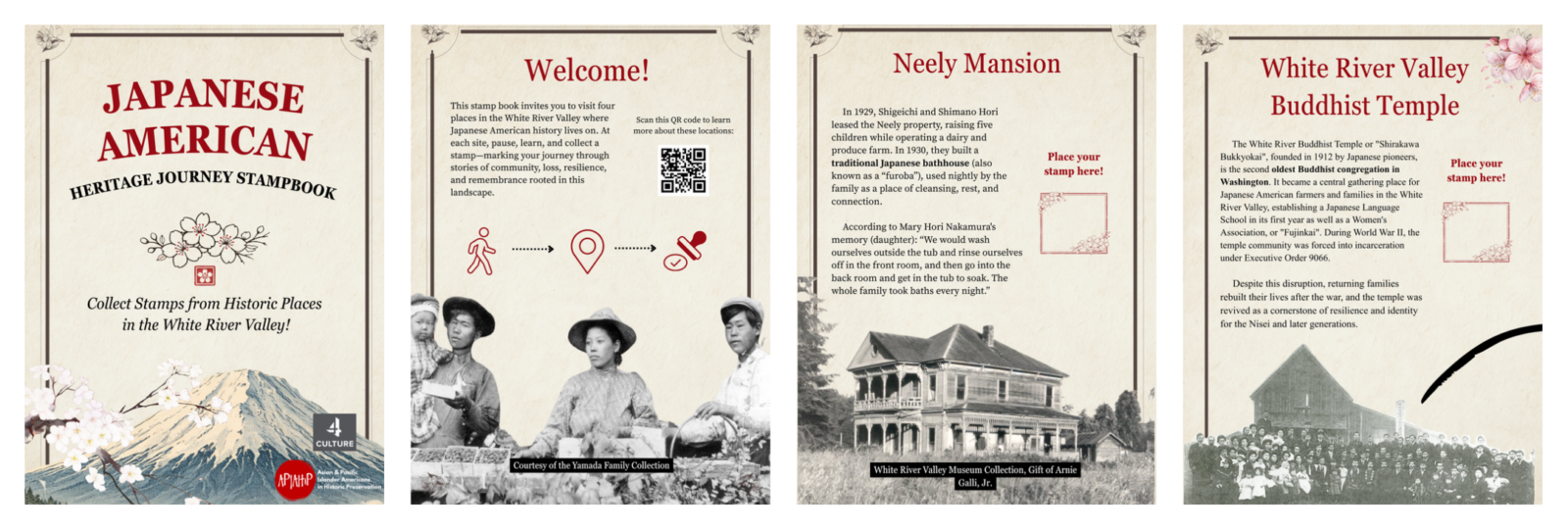
We will celebrate the work of Karino Wada, Asian and Pacific Islander Americans in Historic Preservation (APIAHiP) and 4Culture Beyond Integrity Equity in Historic Preservation Intern. Karino created a digital archive of 30 Japanese American historic places in the White River Valley on Historypin. She also created a hands-on historic site stamp book, an interactive public history tool that will be placed at four locations: Kent Historical Museum, JACL Japanese American Remembrance Gallery at Puyallup Fair, Neely Mansion, and the White River Buddhist Temple, host of the March 8th presentation.
References:
Andrews, Mildred. Japanese-American Legacies in the White River Valley. King County Historic Preservation Program, 1997.
Auburn Pioneer Cemetery. (n.d.). Natsuhara biography. Retrieved October 25, 2025.
Cosgrove, P. (2020, December 29). Pioneer Cemetery becomes a King County and City of Auburn landmark on August 4, 2016. HistoryLink.org Essay 21146.
Neely Mansion Association. (n.d.). Japanese bathhouse – Hori Bathhouse at Neely Mansion. Retrieved November 5, 2025
Wahlgren, Jade (2023). Japanese American sites in the White River Valley [Presentation]. Equity in Historic Preservation Internship, 4Culture and Beyond Integrity.