Extraction and Meaning in Lee Davignon’s Salvage Hues
Growing up in the shadow of Rhode Island’s textile mills, Lee Davignon has been aware of the lives and lore of some of the country’s first industrial workers—the individuals who toiled in those famed mills beginning in the late 18th century, many of them their own ancestors—since childhood. Yet it took moving across the country to Washington State to begin to piece together how their regional family history rhymes with a broader pattern about how our culture thinks about labor, work, time, and value.
“I think a lot about how the industrial movement changed our rhythms. About how going from farming to factory work changed our connection to time. Technology and labor imposed new relationships with time and, in the process, created new labor struggles.
I came into textiles through sewing and weaving and I fell so in love with the process of weaving that it didn’t occur to me that other people—specifically those working in textile mills—might find this annoying or tedious. I also remember that when I was learning about weaving, it became clear that there are these best practices [that were born out of industrialization to standardize and perfect the products].
I feel like as soon as I learned those I began to ask how can I mess with this? What if I relax the tension? How will it come off the loom?”
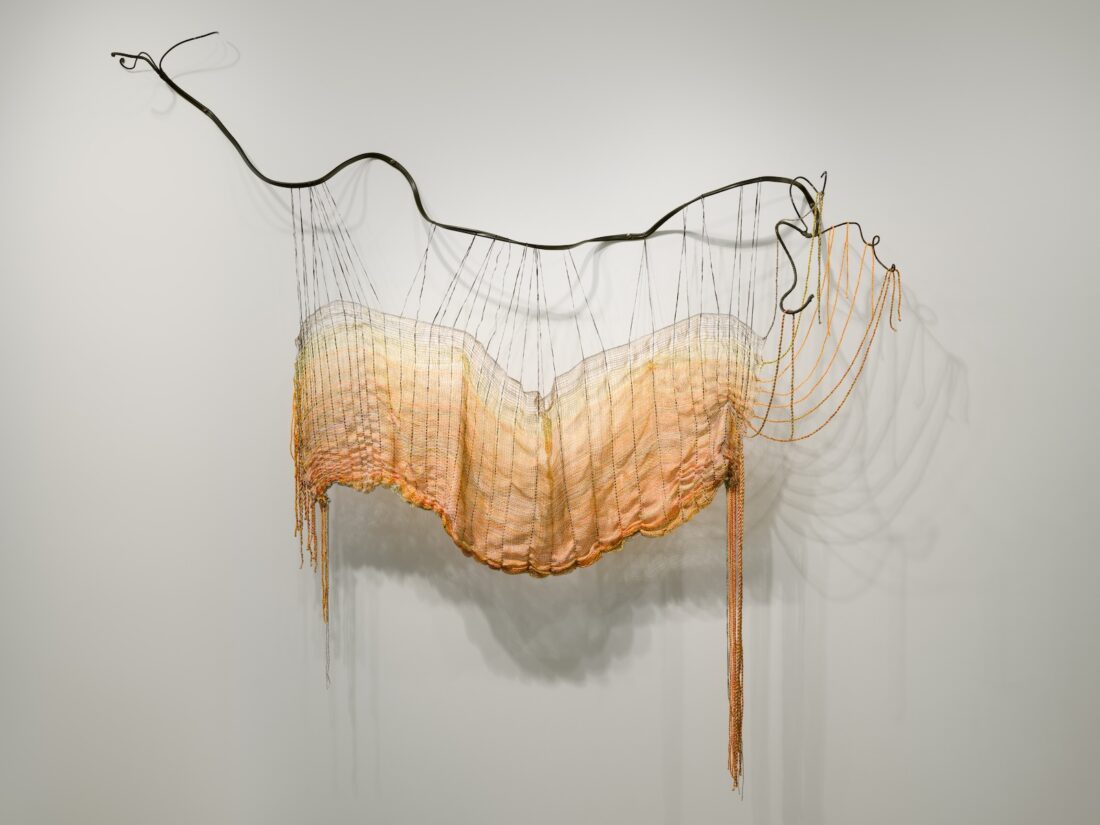
This give-and-take between creating for art or for commerce, and the relationship between process and product, are central to Davignon’s work,which is currently on display in their exhibition, Salvage Hues, at Gallery 4Culture. Even the materials used in these pieces provoke questions about utility and waste. Artists working in the crafts have long extracted materials to create their products—like cotton for fabric, metals for jewelry, wood for furniture, or clay for ceramics and pottery. Davignon instead extracts materials from the waste stream—upcycled fabrics, electrical wiring, rope, scrap metal, and much more.
“I like mining my own waste stream. What can I do with all these end bits? Even when I buy produce and it comes in those mesh bags—I like touching these things and trying to figure out how to make something, or how to ask the material if it will do something for me, like maybe twist it to the point that I could make it a structural fiber—that’s a really interesting and exciting process.”
Most of the pieces in this show were created for the gallery space, and Davignon sourced material from a variety of places, including dead stock and mill ends from shuttered factories in Rhode Island. They also include a lot of romex—a non-metallic, sheathed electrical cable used in residential wiring.
Sometimes these materials take on such an altered appearance they’re almost disguised in Davignon’s work. “Even my friends who are makers couldn’t tell that I was using upcycled material in the actual fiber” because it ended up being so seamlessly integrated and are so interesting or delicate or beautiful in the installation pieces. Nevertheless, it’s how people interact with these pieces that excites Davignon so much.
“I like to observe people interacting with the work, to become more aware of themselves and wondering whether they can see through it, or will they walk around it? Or maybe they see something they recognize—like, is that a scrap of a t-shirt or a straw or something else [hidden in the installation]?”
The first piece (to a visitor’s left) upon entering the gallery—Cloud Zones—employs the romex wire, which supports a larger textile of weft threads that stands away from the wall and is weighted down—or “scrunched”— somewhat by gravity. Davignon notes that this piece might physically change over two months in the gallery because of this, and different visitors might experience it in different ways.
Other pieces in the show draw inspiration from doilies and other handmade items purchased at estate sales or given to the artist by friends and acquaintances. “I had a lot of doilies lying around when I was working on these cordage pieces. I was really interested in the visual structure of the doilies.” The resulting work is an almost abstract take on a doily, yet no stitching was involved. “None of them are stitched. They’re all just kind of fed through the cordage itself, like more of a rope technique.”
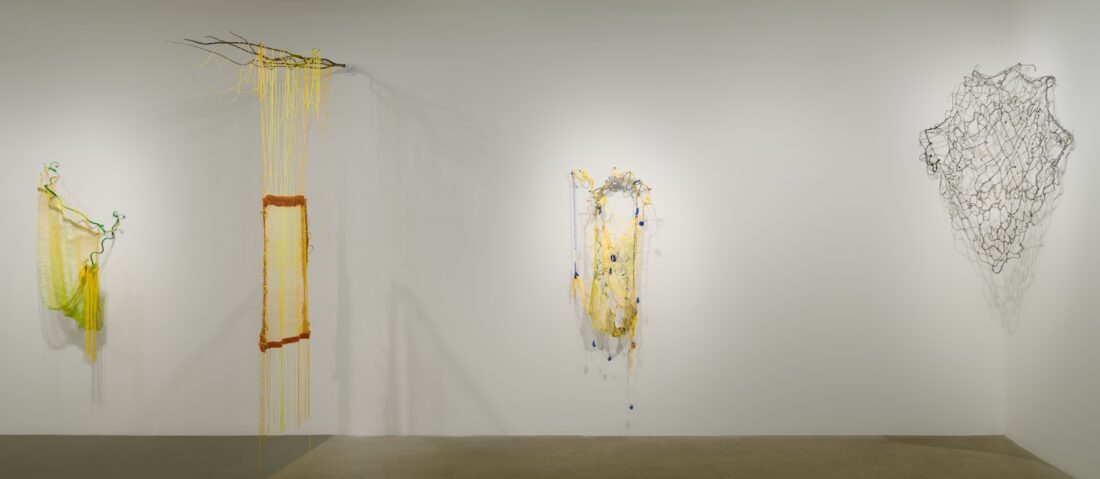
Another piece, called Static Web, a cordage-heavy piece done in black and white is “a little bit of a love letter to spiders, because I have a lot of them in my studio. And, of course, there’s Arachne the weaver [from Greek mythology], which is quite nice.”
Next is a piece called No Dumping, which is one of the most heavy weaving pieces in the show, employing tapestry technique. “I had originally woven a large piece of felt scrap into it, but I ended up cutting it out. And I just love the [remaining] trace of that cutout, kind of like a footprint.”
All the pieces in the show beg questions about the past lives of the materials, our relationship to those materials, and what gets left behind. The process of creating the pieces—and weaving on a loom in general—is intensive, physical work that engages the whole body, which provokes thoughts about labor and production. The show asks that we look at universal materials from different angles, and think about ingenuity and resourcefulness. Davignon draws inspiration from a wide range of fabric histories: neolithic warp-weights, forgotten doilies, the environmental toll of industrial mills on New England’s rivers, and the universal motion of hands plying cordage. Playing with shadow, transparency, and tension, the works aim to trigger tactile memory.
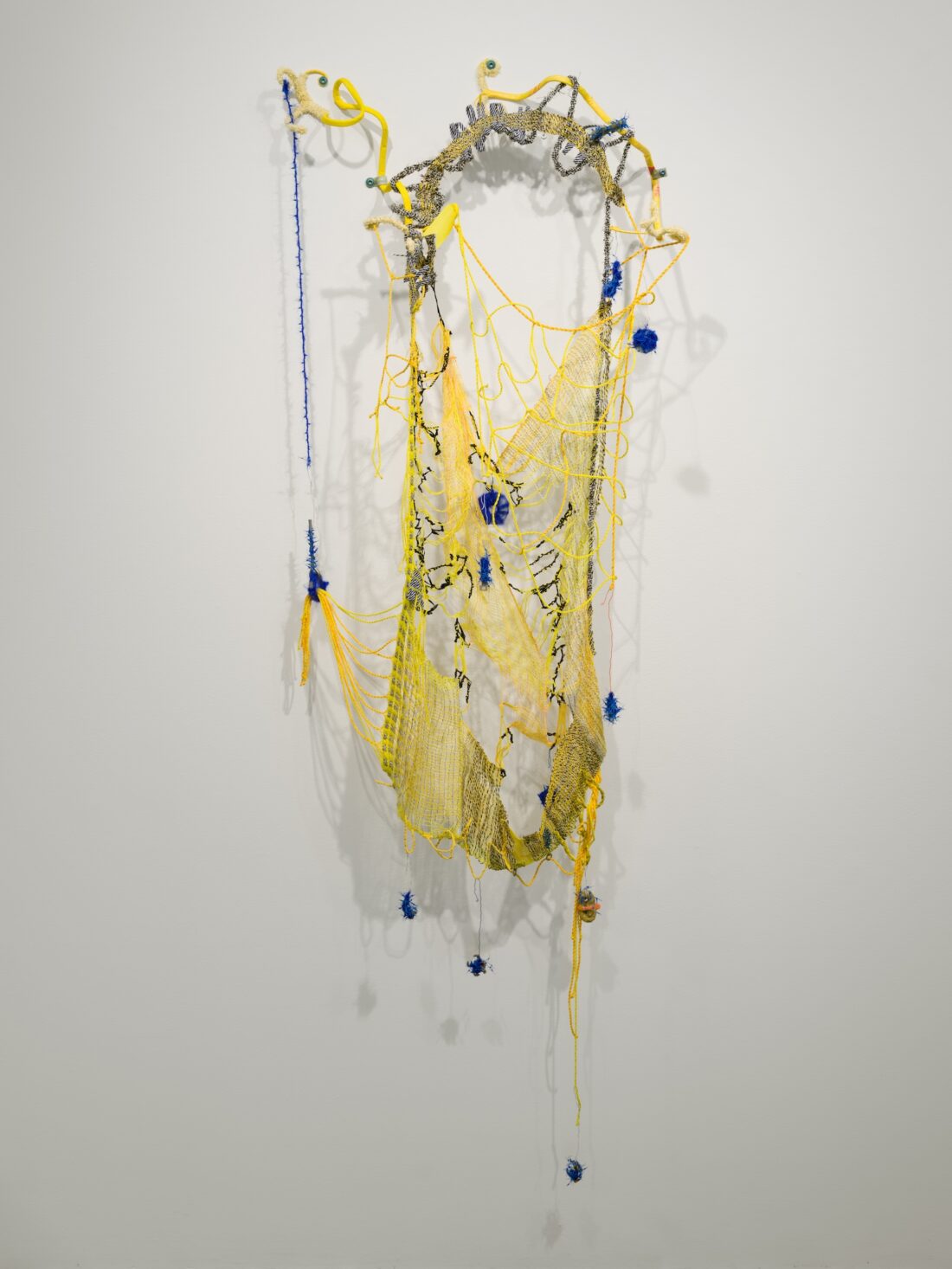
“The work is fairly abstract—maybe very abstract—and I want to give people pause and a moment to look closely at something and find a moment of comfort and familiarity, but also find a renewed interest in the materials [we take for granted] in our own lives, to think about the things we mindlessly discard.”
Davignon has a small trash can in their studio, but empties it only once or twice a year at most. “A lot of the material I use is cast off. It won’t work any longer for the purpose it has been created for. It’s now obsolete. Using up every little bit is very interesting to me. I believe there’s a way to take things that are no longer useful, that we no longer think of as useful, and find some utility in them.”
Salvage Hues is on view through April 24. Join Davignon on Thursday, April 2 from 5:30 – 6:30pm during the Art Walk for a Q&A style artist talk.
Born in Providence, RI, Lee Davignon is a textile artist working in the Cascade foothills of Washington State. A weaver for 17 years, Davignon’s work emerges from material-led investigation at the intersection of waste stream materials and an extensive library of craft skills. They earned their BFA in Fibers from the Massachusetts College of Art and Design in 2013. Davignon has been an artist in residence at Recology King County, and their work has been shown recently at the Fuller Craft Museum, the Pacific Northwest Museum of Quilts and Fiber Art, Mini Mart City Park, Carnation Contemporary, Seattle Art Fair, Shunpike Storefronts, and Schack Art Center. They have been an artist member of SOIL Gallery since 2023.