Memories, not memes: Reilly Jensen’s witty and wild Eldermaxxing asks us to ditch the screen and live IRL.
Reilly Jensen pays attention. She traces her creative origins to her rural Kansas upbringing where she found interesting ideas and inspiration in the overlooked and ordinary—in the detritus of everyday life, the inherited habits and artifacts of small town life, and in the quiet, tactile rituals that shape each of our personal stories. Her father was a guy who “put stuff together”—a man who tinkered and collected things not because they were valuable, but because they were interesting.
This early exposure to the joys of making and improvising inspired a lifelong practice of gathering objects that most people might discard, but that Reilly sees as raw material for creation. For years, these found objects sat in her studio while she worked as a graphic designer, then as a painter. At some point, she had accumulated so much stuff that she decided to start creating art out of the material she had on hand. She describes the shift to found objects as not just stylistic, but as personally liberating. Raised by parents who worried about what others thought, Reilly had internalized some of the art world’s conventional thinking about what makes “good” art. She was now, in her own way, pushing back against norms.
Each piece begins in a sketchbook where she jots down ideas—things that amuse her, surprise her, irritate her, and other moments that feel striking or absurd about contemporary life. She then builds each piece with what she has on hand in the studio: burlap, denim, three-dimensional fragments of the material world. Engineering these elements into coherent works of art required her to teach herself how to sew on her mother’s machine and to solve structural problems, like how the pieces will hang, how the different material all holds together, and how the finished work will occupy physical space. For Jensen, that problem-solving is part of the pleasure. It’s where the mechanical aptitude she inherited by observing her father meets her chosen artistic sensibility. The details and the craftsmanship reveal a process that is slow, methodical, tactile, and disciplined—a deliberate counterpoint to the way we live now.
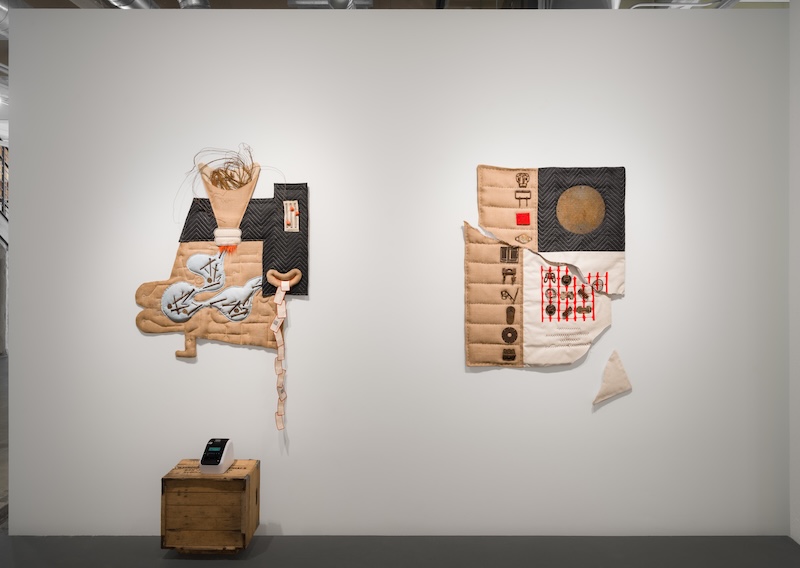
Her work leans into a folk art sensibility that Jensen embraces as both lineage and a sort of protest. She loves folk art and recognizes, in hindsight, that her father’s inventions and handmade contraptions were a kind of folk practice themselves. There’s deliberate grit and humor in the work—each piece feels like a character, or a short story assembled from fragments that once had other lives of their own. The work wrestles with decay, obsolescence, the cost of progress. She explores the present by paying attention to what gets thrown away—not just the objects themselves, but skills, habits, values, the wisdom of elders—when the larger culture decides to move on.
The show’s title, Eldermaxxing, signals an engagement with our current generational tensions. The title of the show borrows from the grotesque social media subculture of “looksmaxxing,” where young men obsessively manipulate their faces and bodies to achieve physical perfection. Jensen poses a sardonic counter question: what does it mean to “maxx out” elderhood? The pieces in this show dispute the idea that everything old is irrelevant and asks viewers to reconsider what’s been deemed obsolete—and at whose expense. Yet the show is also intended to spark a conversation about generational differences and what we might learn from one another.
Asked about the pieces in the show, Reilly brings her signature, highly approachable wit when describing what visitors can expect to see. “These pieces seem like characters to me. I watched a lot of cartoons when I was young,” and she hints that these pieces brim with playful and outlandish personalities. But more importantly, “this body of work strives to poke the young while humoring those of us who are older. I’m reminding everyone that the real world—the one you can touch and feel—has value and produces lasting memories.”
Highlights from the current Gallery 4Culture show, in the artist’s own words:
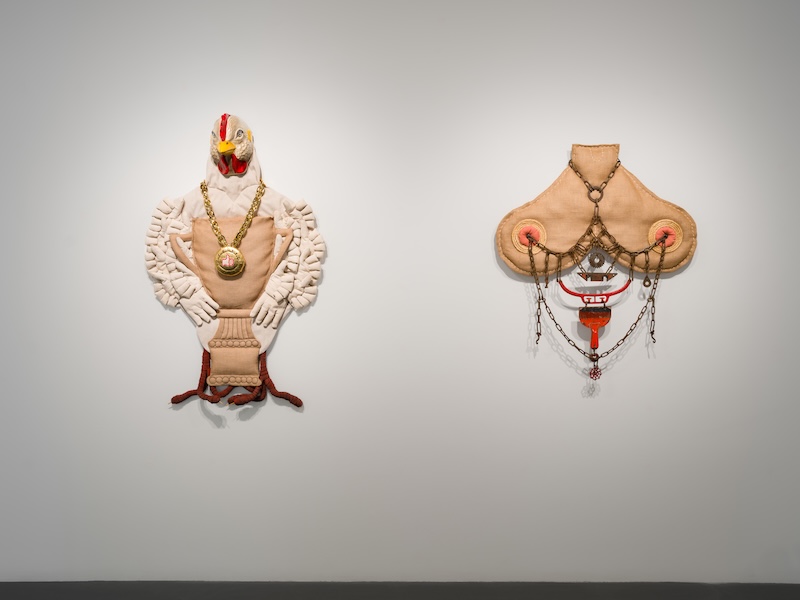
The Participation Trophy: “When I was a kid you had to win your trophies. You weren’t handed one just for showing up. The advent of the “participation trophy” seems to me to negate the point of learning resilience and determination.”
Certified Humane: This one is all about living life IRL. “Grilling a brat, drinking a beer, and hangin’ out with real, live people. It’s just good, clean, old FUN!”
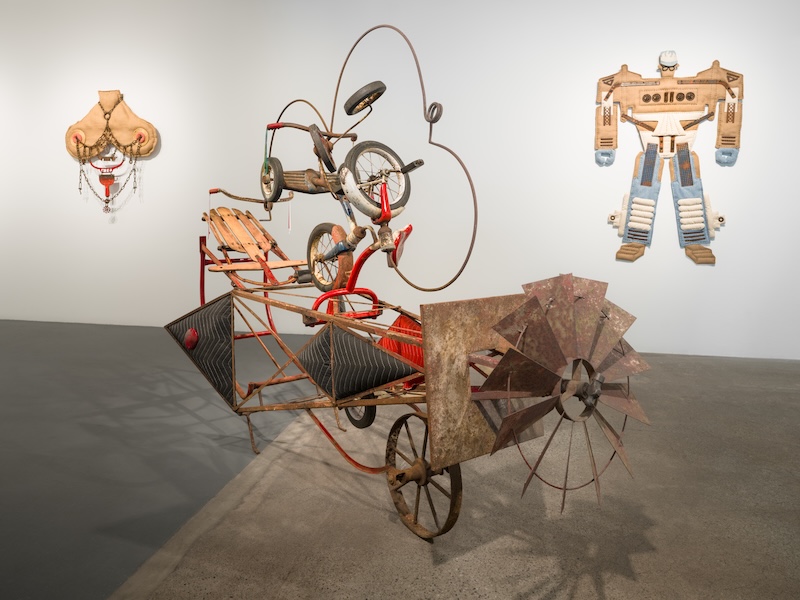
Self Portrait: “This one is a Transformer made of denim, burlap, and old rusty parts. I think that’s just funny in and of itself. And after all, aging itself is all about transformation and adaptation.”
The Time Machine: “This sculpture mixes nostalgia and whimsy by returning to my childhood memories of whizzing across the Kansas prairie on my trike or sled, but this time atop an imaginary rickety—but very efficient—time-travelin’ windmill.”
Trucker Hat and Boob Broach: These are all about this old dyke’s strength and my sustained ability to still swing a hammer AND to still rock a trucker hat.”
Underneath the work in Eldermaxxing runs a fun and approachable critique of how technology hijacks our culture and psyches. The show is an antidote to our digital obsessions. Jensen’s artwork re-centers us around ideas of mortality, imperfection, and the sheer pleasure of making something tangible with your bare hands. She hopes people will step away from the screen long enough to experience how time, touch, and labor can turn discarded items—whether objects, memories, or even older people themselves—into sources of meaning and inspiration.